top of page

Electrical Machine
-Generators and motors
-Dc Machines
-3∅ A.c Machines Effciency = useful power out
-1∅ A.c Machines total power in
1. dc machines
mechanical power --> (generator) --> electrical power
Electrical power --> (motor) --> Mechanical power
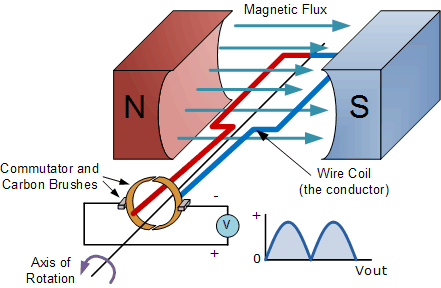
Simple Dc Machine
Motor F=BIC
Gen E=BLV
As conductors cut across flux lines an EMF is induced
when direction the conductors are moving in is at 90o to flux lines - max emf
when they are parallel - zero emf
also emf changes direction every 1/2 cycle (180o)
the commuter changes polarity every 1/2 cycle, turning Ac into DC
if the supplied current is in one direction only, the force will be in
one direction too, The armature will be stuck in one position.
if we connect using a commutator, the current will change direction every 1/2 cycle as will the force. The armature will continue to roatate.

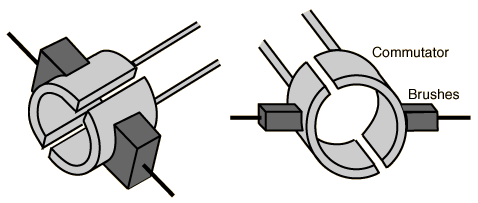

Segmented commutator
Each paid of segments connects to each set of windings, only the desired windings are connected to the circuit
In any position, the armature will have windings in the optimum location.
Types of DC Motors
3 types series
Shunt (parallel)
Compound (mix of both)
Instead of magnets, we use coils to create magnetic field.
I series (universal motor - it works on D.c or A.c
Reversing. change field or armature direction but not both.
Dc generators have few applications.
Power tools
AC motors - induction motors
How do they work?
Field windings - AC current and magnetic field
No brushes
Current gets to the rotor by induction.
This current produces its own magnetic field.
2 magnetic fields --> force
3∅ induction motor.
3 sets of windings - one for each phase.
The sets of windings take turns in producing the maximum magnetic field.
a 3∅ induction motor creates a rotating magneticfield, The rotor has no electrical or mechanical connection with the stator. Currents are induced in the rotor by the rotating stator field. These currents produce there own magnetic field, the two fields (internal and external) interact producing a force.
Unlike 3∅ motors that are self starting, 1∅ motors require a 'kick' to start the rotation.
Once started the rotor will turn attracted to each pole in urn the stator field changes polarity.
There are a number of ways of starting a 1∅ induction motor.
1. split-phase motor
this has two sets of windings
run windings (main)
and start windings. (offset to one side)
For this to work we need a slight delay between start and run windings.
But, these windings are all inductors and we know from CIVIL that inductors give us a lag.
Run windings - use heavy gauge wire R->low
Start windings - use fine wire R->high
2. capacitor start
Capacitor connected to start windings. From CIVIL we get a lead --> delay between start and run.
Centrifugal switch again. Switches off start windings when motot is up to speed.
3. shaded pole motor.
- simple type of motor.
The shading ring is a simple inductor (coil with 1 turn)
CIVIL --> Lag
4. universal motor
A.C but not an induction motor (same as series D.C motor)
When using ac, as the supply changes polarity
the magnetic field also changes
But so does the current in the armature, These cancel out and the motor turns in the same direction throughout the cycle.
Rotors
There are two types, Cage rotor
and wound rotor
Which is more like a DC armature)
Thin wire used but very high number of turns so altough current is low due to high resistance of windings the magnetic field is strong because of the number of turns.
Applications of 1∅ motors
Split phase:
Poor starting torque
Maintains constant with carying loads
Belt drives - Production lines
Maintains constant
Speed with varying loads
Motor starting (speed control)
2 problems, Starting high torque
Rotor resistance starter.
Current in the rotor is restricted by adding resistors
This only works for wound rotors connecting to the resistance via sliprings
The resistance is removed from the circuit at a pre-determined speed.
electronic starters (soft start)
Control Either voltage or current
_variable frequency control (used on larger motors)
Variabe frequency control (larger motors)
Changing f Varies the reactance of the coils (windings)
Slip
The speed of rotation for the ext al (stator) rotating magnetic field is called synchronous speed (Ns)
f
Ns = p x60
d - cycles per second
Ns - Revolutions per minute.
f - Supply frequency
p - number of pairs of poles
Nr is the rotor speed
Nr is always less than Ns
Slip is the difference between Ns and Nr
Slip = Ns-Nr
can be a decimal or a difference
0.04 - 4%

bottom of page